Showing posts with label Company - Netflix. Show all posts

Tuesday, January 26, 2016

Design Netflix | Cracking Code Interview


Design Netflix | Cracking Code Interview
设计一个 Netflix
架构上:基本上就是数据层,Service层,前端。因为Netflix是AWS的忠实用户,所以基本就以AWS为例:数据存储使用s3,配合Relational db / Non sql database;然后是Service layer,功能包括:User authentication,session management,data streaming and other business logic;前台则主要是用户界面。优化包括:如何Cache,如何利用CDN network replicate data close to the users. 因为Netflix的数据大部分是静态数据,很少更新,电影电视剧的内容完全可以Replicate很多份放到Internet的Edge server上。
follow up 很多 比如如何限制同一个用户多处登录不能同时看一个资源,如何实现根据用户的网速调整清晰度,怎么热门推荐等等。
https://www.google.com/patents/CN104010232A?cl=zh
本发明公开了一种智能播放在线视频的方法、系统、播放器及移动终端,方法包括:预先将视频按低到高不同等级码率切片成若干个版本的切片视频,每个版本的切片视频与不同等级码率对应;在初始播放时,播放器先从最低等级码率的版本中加载与最低等级码率对应的第一切片视频进行播放;当视频播放稳定后,播放器自动检测网络状况,根据当前的网络状况对应的码率及播放终端所能支持的分辨率,选择合适等级码率的视频切片进行加载和播放

如何限制同一个用户多处登录不能同时看一个资源
-- store accountid and current sessionid in table or redis
-- if already login, write new sessionid in the table
-- push notification to old session then invalidate the old session
Read full article from Design Netflix | Cracking Code Interview

Wednesday, October 7, 2015

The netflix Architecture


http://highscalability.com/blog/2017/12/11/netflix-what-happens-when-you-press-play.html
The three parts of Netflix: client, backend, content delivery network (CDN).
You can think of Netflix as being divided into three parts: the client, the backend, and the content delivery network (CDN). 
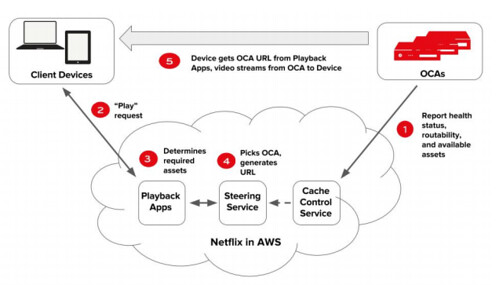
Everything that happens after you hit play is handled by Open Connect. Open Connect is Netflix’s custom global content delivery network (CDN). Open Connect stores Netflix video in different locations throughout the world. When you press play the video streams from Open Connect, into your device, and is displayed by the client

The source of source media.
Who sends video to Netflix? Production houses and studios. Netflix calls this video source media. The new video is given to the Content Operations Team for processing. 
Validating the video.
Into the media pipeline.
It’s not practical to process a single multi-terabyte sized file, so the first step of the pipeline is to break the video into lots of smaller chunks. 
The video chunks are then put through the pipeline so they can be encoded in parallel. In parallel simply means the chunks are processed at the same time. 
The idea behind a CDN is simple: put video as close as possible to users by spreading computers throughout the world. When a user wants to watch a video, find the nearest computer with the video on it and stream to the device from there.
The biggest benefits of a CDN are speed and reliability. 
Each location with a computer storing video content is called a PoP or point of presence. Each PoP is a physical location that provides access to the internet. It houses servers, routers, and other telecommunications equipment

Netflix put a lot of time and effort into developing smarter clients. Netflix created algorithms to adapt to changing networks conditions. Even in the face of errors, overloaded networks, and overloaded servers, Netflix wants members always viewing the best picture possible. One technique Netflix developed is switching to a different video source—say another CDN, or a different server—to get a better result.

Video distribution is a core competency for Netflix and could be a huge competitive advantage. 

Open Connect has a lot of advantages for Netflix:
  • Less expensive. 3rd-party CDNs are expensive. Doing it themselves would save a lot of money.
  • Better quality. By controlling the entire video path—transcoding, CDN, clients on devices—Netflix reasoned it could deliver a superior video viewing experience.

Netflix knows exactly which videos it needs to serve. Just knowing it only has to serve large video streams allows Netflix to make a lot of smart optimization choices other CDNs can’t make. Netflix also knows a lot about it members. The company knows which videos they like to watch and when they like to watch them. 


Open Connect Appliances
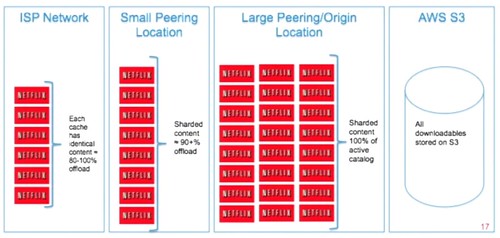
There are several different kinds of OCAs for different purposes. There are large OCAs that can store Netflix’s entire video catalog. There are smaller OCAs that can store only a portion of Netflix’s video catalog. Smaller OCAs are filled with video every day, during off-peak hours, using a process Netflix calls proactive caching. 

The number of OCAs on a site depends on how reliable Netflix wants the site to be, the amount of Netflix traffic (bandwidth) that is delivered from that site, and the percentage of traffic a site allows to be streamed. 
When you press play, you’re watching video streaming from a specific OCA, like the one above, in a location near you. 
Other video services, like YouTube and Amazon, deliver video on their own backbone network. These companies literally built their own global network for delivering video to users. That’s very complicated and very expensive to do. 
Netflix took a completely different approach to building its CDN.
Netflix doesn’t operate its own network; it doesn’t operate its own datacenters anymore either. Instead, internet service providers (ISPs) agree to put OCAs in their datacenters. OCAs are offered free to ISPs to embed in their networks. Netflix also puts OCAs in or close to internet exchange locations (IXPs). 
Using this strategy Netflix doesn’t need to operate its own datacenters, yet it gets all the benefits of being in a regular datacenter it’s just someone else’s datacenter. Genius!
Using ISPs to build a CDN.
Using IXPs to build a CDN.
An internet exchange location is a datacenter where ISPs and CDNs exchange internet traffic between their networks. It’s just like going to a party to exchange Christmas presents with your friends
Each wire in the above picture connects one network to another network. That’s how different networks exchange traffic with each other. 

Netflix has all this video sitting in S3.
Netflix uses a process it calls proactive caching to efficiently copy video to OCAs.
Netflix caches video by predicting what you’ll want to watch. 
Netflix uses its popularity data to predict which videos members probably will want to watch tomorrow in each location. Here, location means a cluster of OCAs housed within an ISP or IXP.
Netflix copies the predicted videos to one or more OCAs at each location. This is called prepositioning. Video is placed on OCAs before anyone even asks. 
Netflix operates what is called a tiered caching system. 
The smaller OCAs we talked about earlier are placed in ISPs and IXPs. These are too small to contain the entire Netflix catalog of videos. Other locations have OCAs containing most of Netflix’s video catalog. Still, other locations have big OCAs containing the entire Netflix catalog. These get their videos from S3. 
Every night, each OCA wakes up and asks a service in AWS which videos it should have. The service in AWS sends the OCA a list of videos it’s supposed to have based on the predictions we talked about earlier.
Each OCA is in charge of making sure it has all the videos on its list. If an OCA in the same location has one of the videos it’s supposed to have, then it will copy the video from the local OCA. Otherwise, a nearby OCA with the video will be found and copied. 
Since Netflix forecasts what will be popular tomorrow, there’s always a one day lead time before a video is required to be on an OCA. This means videos can be copied during quiet, off-peak hours, substantially reducing bandwidth usage for ISPs.
There’s never a cache miss in Open Connect
Since Netflix knows all the videos it must cache, it knows exactly where each video is at all times. If a smaller OCA doesn’t have a video, then one of the larger OCAs is always guaranteed to have it.

Only when there are a sufficient number of OCAs with enough copies of the video to serve it appropriately, will the video be considered live and ready for members to watch.


When my Google query is routed onto the internet it’s not on Comcast’s network anymore, and it’s not on Google’s network. It’s on what’s called the internet backbone
The internet is woven together from many privately owned networks that choose to interoperate with each other. The IXPs we looked at earlier are one way networks connect with each other.
up to 100% of Netflix content is being served from within ISP networks. This reduces costs by relieving internet congestion for ISPs.

What happens when an OCA fails? The Netflix client you’re using immediately switches to another OCA and resumes streaming. 
What happens if too many people in one location use an OCA? The Netflix client will find a more lightly loaded OCA to use.
Netflix Controls The Client
But even on platforms like Smart TVs, where Netflix doesn’t build the client, Netflix still has control because it controls the software development kit (SDK).

By controlling the SDK, Netflix can adapt consistently and transparently to slow networks, failed OCAs, and any other problems that might arise.
  • New video content is transformed by Netflix into many different formats so the best format can be selected for viewing based on the device type, network quality, geographic location, and the member’s subscription plan.
  • Every day, over Open Connect, Netflix distributes video throughout the world, based on what they predict members in each location will want to watch.

Netflix's Viewing Data: How We Know Where You Are in House of Cards
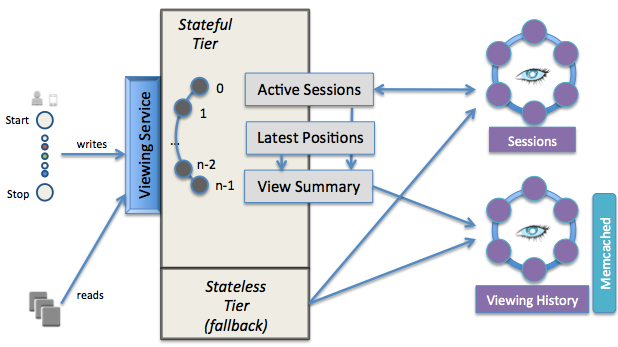
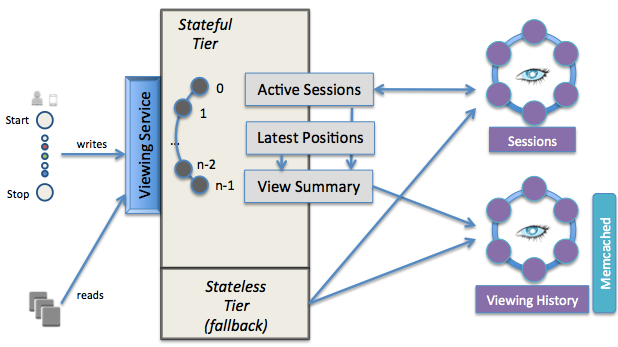
The current architecture’s primary interface is the viewing service, which is segmented into a stateful and stateless tier.  The stateful tier has the latest data for all active views stored in memory.  Data is partitioned into N stateful nodes by a simple mod N of the member’s account id.  When stateful nodes come online they go through a slot selection process to determine which data partition will belong to them.  Cassandra is the primary data store for all persistent data.  Memcached is layered on top of Cassandra as a guaranteed low latency read path for materialized, but possibly stale, views of the data.


We started with a stateful architecture design that favored consistency over availability in the face of network partitions (for background, see the CAP theorem).  At that time, we thought that accurate data was better than stale or no data.  Also, we were pioneering running Cassandra and memcached in the cloud so starting with a stateful solution allowed us to mitigate risk of failure for those components.  The biggest downside of this approach was that failure of a single stateful node would prevent 1/nth of the member base from writing to or reading from their viewing history.


After experiencing outages due to this design, we reworked parts of the system to gracefully degrade and provide limited availability when failures happened.  The stateless tier was added later as a pass-through to external data stores. This improved system availability by providing stale data as a fallback mechanism when a stateful node was unreachable.

Next Generation Architecture

  • Availability over consistency - our primary use cases can tolerate eventually consistent data, so design from the start favoring availability rather than strong consistency in the face of failures.
  • Microservices - Components that were combined together in the stateful architecture should be separated out into services (components as services).
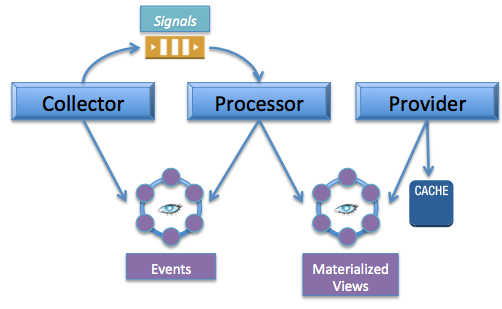
    • Components are defined according to their primary purpose - either collection, processing, or data providing.
    • Delegate responsibility for state management to the persistence tiers, keeping the application tiers stateless.
    • Decouple communication between components by using signals sent through an event queue.
  • Polyglot persistence - Use multiple persistence technologies to leverage the strengths of each solution.
    • Achieve flexibility + performance at the cost of increased complexity.
    • Use Cassandra for very high volume, low latency writes.  A tailored data model and tuned configuration enables low latency for medium volume reads.
    • Use Redis for very high volume, low latency reads.  Redis’ first-class data type support should support writes better than how we did read-modify-writes in memcached.
http://www.computerworld.com/article/2489741/networking/how-netflix-streams-movies-to-your-tv.html
Netflix also designs its own storage hardware, custom built for streaming video. It uses two types of server, one based on hard disk drives and the other on flash drives, and both are optimized for high-density and low-power use.

during quiet periods between midnight and lunchtime it prepopulates the servers with the content it thinks people will want to watch, reducing bandwidth use in peak hours.

The content still has to get from the CDN to end users, and it's carried by local ISPs (Internet service providers) who connect to the CDN in one of two ways: they peer with it at common Internet exchanges -- basically big data centers where different network providers connect to each other -- or they can install Netflix's storage systems, which it provides them for free, on their own premises.

The company operates its own content delivery network (CDN), a global network of storage servers that cache content close to where it will be viewed. That local caching reduces bandwidth costs and makes it easier to scale the service over a wide area.

It also does lots of intelligent mapping in the network, to figure out the best location to stream each movie from.
https://www.quora.com/What-technology-stack-is-Netflix-built-on
http://www.slideshare.net/adrianco/netflix-architecture-tutorial-at-gluecon
Adopting Microservices at Netflix: Lessons for Architectural Design
http://netflix.github.io/#repo
http://stackshare.io/netflix/netflix


https://medium.com/netflix-techblog/netflixs-viewing-data-how-we-know-where-you-are-in-house-of-cards-608dd61077da


https://www.scalescale.com/the-stack-behind-netflix-scaling/
http://www.infoq.com/cn/news/2015/11/ScaleScale-MaxCDN-NetFlix
而且,Netflix更多的希望员工能够参与到策略或者决策中,清楚知道项目的来龙去脉和自己在项目中的定位。
倚重多种Amazon服务
Netflix的框架运行在Amazon EC2中,其数字电影的主要拷贝存储在Amazon S3中。根据视频分辨率和音频质量,Netflix需要将每一个电影利用云端编码为50多个版本。因此,共计超过1PB的数据存储在Amazon中。这些内容通过内容传输网络(CDN)发送到不同ISP中。
Netflix在其后端采用了包括Java、MySQL、Gluster、Apache Tomcat、Hive、Chukwa、Casandra和Hadoop等在内的很多开源软件。
支持多种设备
在Netflix,不同编译码器和比特率的组合意味着,相同内容需要经过120次不同的编码才能被发送到流平台中。
尽管Netflix采用了自适应的比特率技术来调整视频和音频质量,以适应客户的下载速度,他们还额外提供了在网站中手动选择视频质量的选项。
用户可以通过计算机、DVD、蓝光播放器、HDTV、家庭影院系统、手机和平板电脑等任何包含Netflix应用的联网设备来观看视频。
为了适应不同设备和连接速度,Netflix提供了以下编解码方式:
Netflix Open Connect CDN
Netflix Open Connect CDN用于拥有超过10万个订阅者的大型ISP。为了减少网络传输代价,ISP的数据中心中专门包含了低功耗、高存储密度的Netflix内容缓存器。该缓存器运行FreeBSD操作系统、nginx和Bird互联网路由程序。

Saturday, September 12, 2015

How to design netflix


https://medium.com/netflix-techblog/netflixs-viewing-data-how-we-know-where-you-are-in-house-of-cards-608dd61077da
Each time a member starts to watch a movie or TV episode, a “view” is created in our data systems and a collection of events describing that view is gathered. Given that viewing is what members spend most of their time doing on Netflix, having a robust and scalable architecture to manage and process this data is critical to the success of our business.

What titles have I watched?

Our system needs to know each member’s entire viewing history for as long as they are subscribed. This data feeds the recommendation algorithms so that a member can find a title for whatever mood they’re in. It also feeds the “recent titles you’ve watched” row in the UI.
What gets watched provides key metrics for the business to measure member engagement and make informed product and content decisions.

Where did I leave off in a given title?

For each movie or TV episode that a member views, Netflix records how much was watched and where the viewer left off. This enables members to continue watching any movie or TV show on the same or another device.

What else is being watched on my account right now?

Sharing an account with other family members usually means everyone gets to enjoy what they like when they’d like. It also means a member may have to have that hard conversation about who has to stop watching if they’ve hit their account’s concurrent screens limit. To support this use case, Netflix’s viewing data system gathers periodic signals throughout each view to determine whether a member is or isn’t still watching.
Current Architecture
Our current architecture evolved from an earlier monolithic database-backed application (see this QCon talk or slideshare for the detailed history). 

Current Architecture Diagram

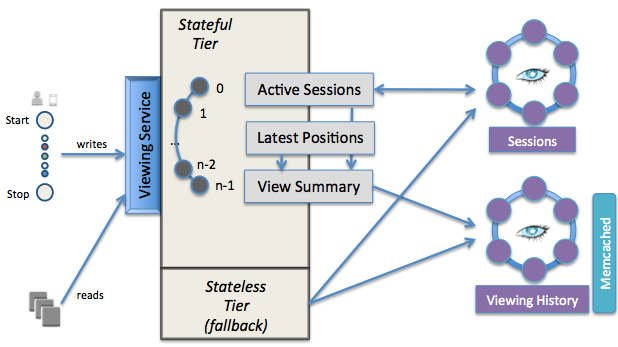
The current architecture’s primary interface is the viewing service, which is segmented into a stateful and stateless tier. The stateful tier has the latest data for all active views stored in memory. Data is partitioned into N stateful nodes by a simple mod N of the member’s account id. When stateful nodes come online they go through a slot selection process to determine which data partition will belong to them. Cassandra is the primary data store for all persistent data. Memcached is layered on top of Cassandra as a guaranteed low latency read path for materialized, but possibly stale, views of the data.
We started with a stateful architecture design that favored consistency over availability in the face of network partitions (for background, see the CAP theorem). At that time, we thought that accurate data was better than stale or no data. Also, we were pioneering running Cassandra and memcached in the cloud so starting with a stateful solution allowed us to mitigate risk of failure for those components. The biggest downside of this approach was that failure of a single stateful node would prevent 1/nth of the member base from writing to or reading from their viewing history.
After experiencing outages due to this design, we reworked parts of the system to gracefully degrade and provide limited availability when failures happened. The stateless tier was added later as a pass-through to external data stores. This improved system availability by providing stale data as a fallback mechanism when a stateful node was unreachable.

Breaking Points

Our stateful tier uses a simple sharding technique (account id mod N) that is subject to hot spots, as Netflix viewing usage is not evenly distributed across all current members. Our Cassandra layer is not subject to these hot spots, as it uses consistent hashing with virtual nodes to partition the data. Additionally, when we moved from a single AWS region to running in multiple AWS regions, we had to build a custom mechanism to communicate the state between stateful tiers in different regions. This added significant, undesirable complexity to our overall system.
We created the viewing service to encapsulate the domain of viewing data collection, processing, and providing. As that system evolved to include more functionality and various read/write/update use cases, we identified multiple distinct components that were combined into this single unified service. These components would be easier to develop, test, debug, deploy, and operate if they were extracted into their own services.
Memcached offers superb throughput and latency characteristics, but isn’t well suited for our use case. To update the data in memcached, we read the latest data, append a new view entry (if none exists for that movie) or modify an existing entry (moving it to the front of the time-ordered list), and then write the updated data back to memcached. We use an eventually consistent approach to handling multiple writers, accepting that an inconsistent write may happen but will get corrected soon after due to a short cache entry TTL and a periodic cache refresh. For the caching layer, using a technology that natively supports first class data types and operations like append would better meet our needs.
We created the stateful tier because we wanted the benefit of memory speed for our highest volume read/write use cases. Cassandra was in its pre-1.0 versions and wasn’t running on SSDs in AWS. We thought we could design a simple but robust distributed stateful system exactly suited to our needs, but ended up with a complex solution that was less robust than mature open source technologies. Rather than solve the hard distributed systems problems ourselves, we’d rather build on top of proven solutions like Cassandra, allowing us to focus our attention on solving the problems in our viewing data domain.

Next Generation Architecture

In order to scale to the next order of magnitude, we’re rethinking the fundamentals of our architecture. The principles guiding this redesign are:
Availability over consistency — our primary use cases can tolerate eventually consistent data, so design from the start favoring availability rather than strong consistency in the face of failures.
Microservices — Components that were combined together in the stateful architecture should be separated out into services (components as services).
  • Components are defined according to their primary purpose — either collection, processing, or data providing.
  • Delegate responsibility for state management to the persistence tiers, keeping the application tiers stateless.
  • Decouple communication between components by using signals sent through an event queue.
Polyglot persistence — Use multiple persistence technologies to leverage the strengths of each solution.
  • Achieve flexibility + performance at the cost of increased complexity.
  • Use Cassandra for very high volume, low latency writes. A tailored data model and tuned configuration enables low latency for medium volume reads.
  • Use Redis for very high volume, low latency reads. Redis’ first-class data type support should support writes better than how we did read-modify-writes in memcached.
Our next generation architecture will be made up of these building blocks:
Re-architecting a critical system to scale to the next order of magnitude is a hard problem, requiring many months of development, testing, proving out at scale, and migrating off of the previous architecture.

https://puncsky.com/hacking-the-software-engineer-interview#designing-netflix-view-state-service

How Netflix Serves Viewing Data?

Motivation 

How to keep users’ viewing data in scale (billions of events per day)?
Here, viewing data means…
  1. viewing history. What titles have I watched?
  2. viewing progress. Where did I leave off in a given title?
  3. on-going viewers. What else is being watched on my account right now?

Architecture 

Netflix Viewing Data Architecture
The viewing service has two tiers:
  1. stateful tier = active views stored in memory
    • Why? to support the highest volume read/write
    • How to scale out?
      • partitioned into N stateful nodes by account_id mod N
        • One problem is that load is not evenly distributed and hence the system is subject to hot spots
      • CP over AP in CAP theorem, and there is no replica of active states.
        • One failed node will impact 1/nth of the members. So they use stale data to degrade gracefully.
  2. stateless tier = data persistence = Cassandra + Memcached
    • Use Cassandra for very high volume, low latency writes.
      • Data is evenly distributed. No hot spots because of consistent hashing with virtual nodes to partition the data.
    • Use Memcached for very high volume, low latency reads.
      • How to update the cache?
        • after writing to Cassandra, write the updated data back to Memcached
        • eventually consistent to handling multiple writers with a short cache entry TTL and a periodic cache refresh.
      • in the future, prefer Redis’ appending operation to a time-ordered list over “read-modify-writes” in Memcached.
http://codeinterviews.com/Uber-Design-Netflix/

架构上:基本上就是数据层,Service层,前端。因为Netflix是AWS的忠实用户,所以基本就以AWS为例:数据存储使用s3,配合Relational db / Non sql database;然后是Service layer,功能包括:User authentication,session management,data streaming and other business logic;前台则主要是用户界面。优化包括:如何Cache,如何利用CDN network replicate data close to the users. 因为Netflix的数据大部分是静态数据,很少更新,电影电视剧的内容完全可以Replicate很多份放到Internet的Edge server上。
follow up 很多 比如如何限制同一个用户多处登录不能同时看一个资源,如何实现根据用户的网速调整清晰度,怎么热门推荐等等。
http://baozitraining.org/blog/2014-star-startup-interview-uber/
这个其实小编也不太了解,就尽量根据自己之前看过的资料开始一步一步给出自己的Solution,然后进行优化。架构上:基本上就是数据层,Service层,前端。因为小编知道Netflix是AWS的忠实用户,所以基本就以AWS为例:数据存储使用s3,配合Relational db / Non sql database;然后是Service layer,功能包括:User authentication,session management,data streaming and other business logic;前台则主要是用户界面。优化包括:如何Cache,如何利用CDN network replicate data close to the users. 因为Netflix的数据大部分是静态数据,很少更新,电影电视剧的内容完全可以Replicate很多份放到Internet的Edge server上。

http://serverfault.com/questions/67484/what-is-an-edge-server-router-device
It's usually a caching proxy server, located near the user accessing the data, used to improve bandwidth and latency to far away users while lessening the load on central servers.
http://www.w3.org/AudioVideo/9610_Workshop/paper14/paper14.html

https://www.jiuzhang.com/qa/3839/
但是,当面试官要求你在45分钟内设计大规模分布式系统时,你需要指出高层组件并描述它们之间如何交互的,而不是花时间说明如何通过避免缓冲区副本的方式来减少20毫秒反应时间的。
既然完成这个问题基本是不可能的,那么面试官到底想知道些什么?其实他希望你给他一个的概述,定义高级模块,并尽可能简洁地描述组件之间的交互。大概分三个阶段:
1.画一个大框架来表示系统
2.放大框架并把它打散变成5-6个模块
3.简要讨论每个模块的功能。计算,存储,前端,后端,缓存,队列,网络,负载均衡等
1.乱用术语
你可能觉得对于抽象层面的设计,大概在设计面试的时候胡扯就可以了。千万不要这样想! 你的面试官正在选择的可是未来可能每天和他一起工作的同事,任何有经验的面试官都会注意那些随便说像是“No-SQL”,“Mongo DB”和“Hadoop”这些术语的人,你要随时准备好他会问更多的细节和为什么你选择这些技术。如果你没有深刻理解或着没法证明和支持你的方法的时候,不要用比如 “GraphQL”这样的术语或很潮的技术。
2.假装你是某个方面的行家
我听说过一些非常尴尬的情况,应聘者假装是一个行家,但是最后发现,面试官正是该领域的知名专家。
在2006年,我面试微软,我的面试官问我是否实现过B树。我告诉他,我知道B树是什么,用于数据库,其他不记得了。他于是换了话题。后来我发现我的面试官是James Hamilton,他是数据库和分布式系统中最重要的专家。之后几年,我要为微软的Azure实现B+树(大型B+树储存了TB的数据,现在我对B+树略知一二。即便是现在,我也不敢对 James Hamilton 说我知道B+树是什么。)
在面试别人的时候,曾经一个应聘者告诉我他在某个代码库中实现了某些功能。他不知道我加入团队之前,曾经在那个代码库上工作过。我试探了他一下,意识到他仅仅实现了代码库的客户端,并不像他说的一样做了那么多。
上面的事并不常见,下面的事更有可能发生:
1.你的面试官可能正在做你谈论的技术,可以很容易地区分冒牌者和专家。
2.他可能已经问过了这个问题上千次,精通可能的解决方案,他一下就知道你真正理解多少。
所以千万不要假装是一个专家。面试你的人一定比你更了解这个领域,甚至可能是业界专家。
3.即使是熟悉的领域,也不要急于求成
熟悉的领域对你有利,但是也不要急于求成,一下跳到你知道的解决方案,所以你要做这三件事:
1.收集要求。
2.多问问题。你的面试官对你的思考过程更感兴趣。
3.评估多个解决方案,讨论利弊。
无论你是否了解这个领域,这样做都有利于你的面试结果。
4.错误回答典例
(声明:以下是一个假设的对话,如有雷同纯粹巧合)。
面试官:让我们实现Twitter。你要如何存储所有的tweets?
候选人:我要使用NoSQL数据库比如MongoDB。
面试官:为什么不用MySQL?
候选人:RDBMS不可扩展。我们需要一个可扩展的数据库,比如MongoDB或BigTable。
面试官:但是我们在Twitter存储我们在MySQL中的所有tweets,它的扩展性非常好。
候选人:嗯,那也许你的规模不是那么大。当需要更大规模的服务的时候,比如Facebook,就要使用NO-SQL解决方案。
面试官:但Facebook也使用MySQL。
候选人:我不知道他们如何扩展,我必须再做做功课。也许他们用MySQL由BigTable支持前端。
面试官:那好吧。我们应该在哪里存储我们的分析数据?
候选人:显然在MySQL。
面试官:但是对MySQL来说太多了。我们在HDFS中储存。
候选人:可能你们在MongoDB成熟之前搭建的Twitter。 MongoDB可以轻松处理tweets和分析数据。

Labels

Review (572) System Design (334) System Design - Review (198) Java (189) Coding (75) Interview-System Design (65) Interview (63) Book Notes (59) Coding - Review (59) to-do (45) Linux (43) Knowledge (39) Interview-Java (35) Knowledge - Review (32) Database (31) Design Patterns (31) Big Data (29) Product Architecture (28) MultiThread (27) Soft Skills (27) Concurrency (26) Cracking Code Interview (26) Miscs (25) Distributed (24) OOD Design (24) Google (23) Career (22) Interview - Review (21) Java - Code (21) Operating System (21) Interview Q&A (20) System Design - Practice (20) Tips (19) Algorithm (17) Company - Facebook (17) Security (17) How to Ace Interview (16) Brain Teaser (14) Linux - Shell (14) Redis (14) Testing (14) Tools (14) Code Quality (13) Search (13) Spark (13) Spring (13) Company - LinkedIn (12) How to (12) Interview-Database (12) Interview-Operating System (12) Solr (12) Architecture Principles (11) Resource (10) Amazon (9) Cache (9) Git (9) Interview - MultiThread (9) Scalability (9) Trouble Shooting (9) Web Dev (9) Architecture Model (8) Better Programmer (8) Cassandra (8) Company - Uber (8) Java67 (8) Math (8) OO Design principles (8) SOLID (8) Design (7) Interview Corner (7) JVM (7) Java Basics (7) Kafka (7) Mac (7) Machine Learning (7) NoSQL (7) C++ (6) Chrome (6) File System (6) Highscalability (6) How to Better (6) Network (6) Restful (6) CareerCup (5) Code Review (5) Hash (5) How to Interview (5) JDK Source Code (5) JavaScript (5) Leetcode (5) Must Known (5) Python (5)

Popular Posts