How to design robust and predictable APIs with idempotency?
How could APIs be un-robust and un-predictable?
Networks are unreliable.
Servers are more reliable but may still fail.
How to solve the problem? 3 Principles:
Client retries to ensure consistency.
Retry with idempotency and idempotency keys to allow clients to pass a unique value.
In RESTful APIs, the PUT and DELETE verbs are idempotent.
However, POST may cause “double-charge” problem in payment. So we use a idempotency key to identify the request.
If the failure happens before the server, then there is a retry, and the server will see it for the first time, and process it normally.
If the failure happens in the server, then ACID database will guarantee the transaction by the idempotency key.
If the failure happens after the server’s reply, then client retries, and the server simply replies with a cached result of the successful operation.
Retry with exponential backoff and random jitter. Be considerate of the thundering herd problem that servers that may be stuck in a degraded state and a burst of retries may further hurt the system.
For example, Stripe’s client retry calculates the delay like this…
defself.sleep_time(retry_count)# Apply exponential backoff with initial_network_retry_delay on the# number of attempts so far as inputs. Do not allow the number to exceed# max_network_retry_delay.
sleep_seconds = [Stripe.initial_network_retry_delay * (2 ** (retry_count - 1)), Stripe.max_network_retry_delay].min
# Apply some jitter by randomizing the value in the range of (sleep_seconds# / 2) to (sleep_seconds).
sleep_seconds = sleep_seconds * (0.5 * (1 + rand()))
# But never sleep less than the base sleep seconds.
sleep_seconds = [Stripe.initial_network_retry_delay, sleep_seconds].max
sleep_seconds
end
The initial connection could fail as the client tries to connect to a server.
The call could fail midway while the server is fulfilling the operation, leaving the work in limbo.
The call could succeed, but the connection break before the server can tell its client about it.
The easiest way to address inconsistencies in distributed state caused by failures is to implement server endpoints so that they’re idempotent, which means that they can be called any number of times while guaranteeing that side effects only occur once.
When a client sees any kind of error, it can ensure the convergence of its own state with the server’s by retrying, and can continue to retry until it verifiably succeeds. This fully addresses the problem of an ambiguous failure because the client knows that it can safely handle any failure using one simple technique.
This is where idempotency keys come into play. When performing a request, a client generates a unique ID to identify just that operation and sends it up to the server along with the normal payload. The server receives the ID and correlates it with the state of the request on its end. If the client notices a failure, it retries the request with the same ID, and from there it’s up to the server to figure out what to do with it.
The Stripe API implements idempotency keys on mutating endpoints (i.e. anything under POST in our case) by allowing clients to pass a unique value in with the special Idempotency-Key header, which allows a client to guarantee the safety of distributed operations:
Being a good distributed citizen
It’s usually recommended that clients follow something akin to an exponential backoff algorithm as they see errors. The client blocks for a brief initial wait time on the first failure, but as the operation continues to fail, it waits proportionally to 2n, where n is the number of failures that have occurred. By backing off exponentially, we can ensure that clients aren’t hammering on a downed server and contributing to the problem. Furthermore, it’s also a good idea to mix in an element of randomness. If a problem with a server causes a large number of clients to fail at close to the same time, then even with back off, their retry schedules could be aligned closely enough that the retries will hammer the troubled server. This is known as the thundering herd problem.
Make sure that failures are handled consistently. Have clients retry operations against remote services. Not doing so could leave data in an inconsistent state that will lead to problems down the road.
Make sure that failures are handled safely. Use idempotency and idempotency keys to allow clients to pass a unique value and retry requests as needed.
Make sure that failures are handled responsibly. Use techniques like exponential backoff and random jitter. Be considerate of servers that may be stuck in a degraded state.
Once the server knows that a request has definitively finished by either succeeding or failing in a way that’s not recoverable, it stores the request’s results and associates them with the idempotency key. If a client makes another request with the same key, the server simply short circuits and returns the stored results.
Keys are not meant to be used as a permanent request archive but rather as a mechanism for ensuring near-term correctness. Servers should recycle them out of the system beyond a horizon where they won’t be of much use – say 24 hours or so.
To shore up our backend, it’s key to identify where we’re making foreign state mutations; that is, calling out and manipulating data on another system. This might be creating a charge on Stripe, adding a DNS record, or sending an email.
Some foreign state mutations are idempotent by nature (e.g. adding a DNS record), some are not idempotent but can be made idempotent with the help of an idempotency key (e.g. charge on Stripe, sending an email), and some operations are not idempotent, most often because a foreign service hasn’t designed them that way and doesn’t provide a mechanism like an idempotency key.
The reason that the local vs. foreign distinction matters is that unlike a local set of operations where we can leverage an ACID store to roll back a result that we didn’t like, once we make our first foreign state mutation, we’re committed one way or another 1. We’ve pushed data into a system beyond our own boundaries and we shouldn’t lose track of it.
An atomic phase is a set of local state mutations that occur in transactions between foreign state mutations. We say that they’re atomic because we can use an ACID-compliant database like Postgres to guarantee that either all of them will occur, or none will.
Atomic phases should be safely committed before initiating any foreign state mutation. If the call fails, our local state will still have a record of it happening that we can use to retry the operation.
A recovery point is a name of a check point that we get to after having successfully executed any atomic phase or foreign state mutation. Its purpose is to allow a request that’s being retried to jump back to the point in the lifecycle just before the last attempt failed.
For convenience, we’re going to store the name of the recovery point reached right onto the idempotency key relation that we’ll build. All requests will initially get a recovery point of started, and after any request is complete (again, through either a success or definitive error) it’ll be assigned a recovery point of finished. When in an atomic phase, the transition to a new recovery point should be committed as part of that phase’s transaction.
In-band foreign state mutations make a request slower and more difficult to reason about, so they should be avoided when possible. In many cases it’s possible to defer this type of work to after the request is complete by sending it to a background job queue.
In our Rocket Rides example the charge to Stripe probably can’t be deferred – we want to know whether it succeeded right away so that we can deny the request if it didn’t. Sending an email can and should be sent to the background.
By using a transactionally-staged job drain, we can hide jobs from workers until we’ve confirmed that they’re ready to be worked by isolating them in a transaction. This also means that the background work becomes part of an atomic phase and greatly simplifies its operational properties. Work should always be offloaded to background queues wherever possible.
locked_at: A field that indicates whether this idempotency key is actively being worked. The first API request that creates the key will lock it automatically, but subsequent retries will also set it to make sure that they’re the only request doing the work.
params: The input parameters of the request. This is stored mostly so that we can error if the user sends two requests with the same idempotency key but with different parameters, but can also be used for our own backend to push unfinished requests to completion (see the completionist below).
recovery_point: A text label for the last phase completed for the idempotent request (see recovery points above). Gets an initial value of started and is set to finished when the request is considered to be complete.
Loosely speaking, in a web application, an idempotent action is one that can be safely executed against the application multiple times without producing an undesired result. This doesn't mean that each subsequent action will necessarily be accepted - in fact, it may very well be rejected. But, an "idempotent action" implies that it is safe for a consumer to try and run the action against the application multiple times, even in parallel.
the distributed lock was put in place to perform one (or both) of the following duties:
Enforce a constraint across multiple resources.
Reduce processing demands on the server.
For the latter, consider something like generating a PDF document, resizing an image, or performing an rdiff between two binaries. In such cases, a distributed lock was used to ensure that parallel requests for the same action would "fail fast", reducing load on the server. When we move to implement idempotency without distributed locks, we are, to some degree, dismissing this requirement out of hand. We're embracing the idea that processing power is cheap, especially at scale; and, if a server has to perform redundant processing in certain edge-cases, then so be it.
Segregate operations that read data from operations that update data by using separate interfaces. This pattern can maximize performance, scalability, and security; support evolution of the system over time through higher flexibility; and prevent update commands from causing merge conflicts at the domain level.
The query model for reading data and the update model for writing data may access the same physical store, perhaps by using SQL views or by generating projections on the fly. However, it is common to separate the data into different physical stores to maximize performance, scalability, and security; as shown in Figure 3.
Figure 3 - A CQRS architecture with separate read and write stores
The read store can be a read-only replica of the write store, or the read and write stores may have a different structure altogether. Using multiple read-only replicas of the read store can considerably increase query performance and application UI responsiveness, especially in distributed scenarios where read-only replicas are located close to the application instances. Some database systems, such as SQL Server, provide additional features such as failover replicas to maximize availability.
Separation of the read and write stores also allows each to be scaled appropriately to match the load. For example, read stores typically encounter a much higher load that write stores.
CQRS stands for Command Query Responsibility Segregation. At its heart is the notion that you can use a different model to update information than the model you use to read information. For some situations, this separation can be valuable, but beware that for most systems CQRS adds risky complexity.
The mainstream approach people use for interacting with an information system is to treat it as a CRUD datastore.
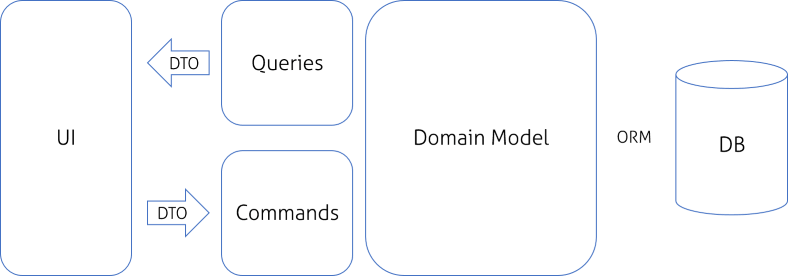
This is typical N-Layer architecture as all of us probably know. If we want to add some CQS here, we can “simply” separate business logic into Commands and Queries:
If you are working with legacy codebase this is probably the hardest step as separating side-effects from reads in spaghetti code is not easy. In the same time this step is probably the most beneficial one; it gives you an overview where your side effects are performed.
Command – First of all,firing command is the only way to change the state of our system. Commands are responsible for introducing allchanges to the system. If there was no command, the state of the system remains unchanged! Command should not return any value. I implement it as a pair of classes: Command and CommandHandler. Command is just a plain object that is used by CommandHandler as input value (parameters) for some operation it represents. In my vision command is simply invoking particular operations in Domain Model (not necessarily one operation per command).
Query – Analogically, query is a READ operation. It reads the state of the system, filters, aggregates and transforms data to deliver it in the most useful format. It can be executed multiple times and will not affect the state of the system. I used to implement them as one class with some Execute (…) method, but now I think that separation to Query and QueryHandler/QueryExecutor may be useful.
Model became the Domain Model. By the Model I understand a group of containers for data while Domain Model encapsulates essential complexity of business rules
the command is responsible for changing state of our system, the essential complexity should be placed in the Domain Model.
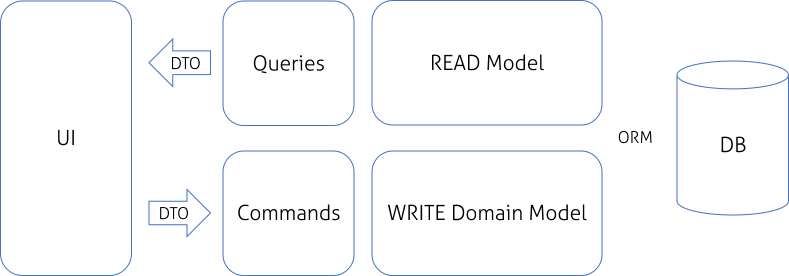
After short period of time it will be quite obvious that Domain Model that works well for writing is not necessarily perfect for reading. It is not a huge discovery that it would be easier to read data from some specialized model:
Now the problem is that we still have READ and WRITE model separated only at the logical level as both of them shares common database. That means we have separated READ model but most likely it is virtualized by some DB Views, in better case Materialized Views. This solution is OK if our system is not suffering from performance issues and we remember to update our queries along with WRITE model changes.
The next step is to introduce fully separated data models:
CQRS != EVENT SOURCING
Event Sourcing is an idea that was presented along with CQRS, and is often identified as a part of CQRS. The idea of ES is simple: our domain is producing events that represent every change made in system. If we take every event from the beginning of the system and replay them on initial state, we will get to the current state of the system. It works similarly to transactions on our bank accounts; we can start with empty account, replay every single transaction and (hopefully) get the current balance. So, if we have stored all events, we can always get the current state of the system.
I like to think about my WRITE model as about the heart of the system. This is my domain model, it makes business decisions, it is important. The fact that it makes business decisions is crucial here, because it defines major responsibility of this model: it represents the true state of the system, the state that can be used to make valuable decisions. This model is the only source of truth.
Read Model
We were forced to pre calculate some data for reports to keep it fast. That was an quite interesting, because in fact we have introduced a cache. And from my point of view this is the best definition of READ model: it is a legitimate cache. Cache that is there by design, and is not introduced because we have to release project and non-functional requirements are not met.
If your project is small and most of your reads can be efficiently made against WRITE model, it will be a waste of time and computing power to create copy. But if your WRITE model is stored as a series of events, it would be useful to have every required data available without replaying all events from scratch. This process is called Eager Read Derivation and from my point of view it is one of the most complex things in CQRS https://www.codeproject.com/Articles/555855/Introduction-to-CQRS
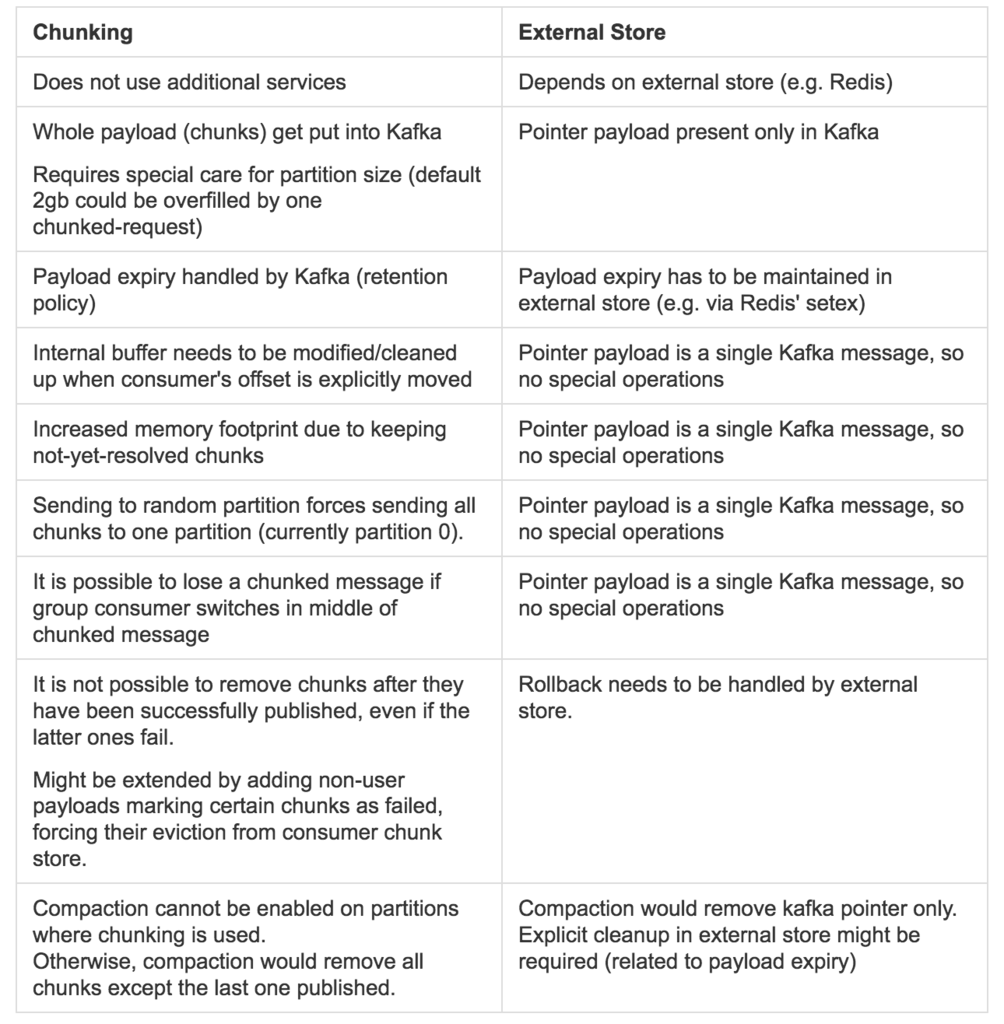
The best way to send large messages is not to send them at all. If shared storage is available (NAS, HDFS, S3), placing large files on the shared storage and using Kafka just to send a message about the file’s location is a much better use of Kafka.
The second best way to send large messages is to slice and dice them. Use the producing client to split the message into small 10K portions, use partition key to make sure all the portions will be sent to the same Kafka partition (so the order will be preserved) and have the consuming client sew them back up into a large message.
Kafka producer can be used to compress messages. If the original message is XML, there’s a good chance that the compressed message will not be very large at all. Use compression.codec and compressed.topics configuration parameters in the producer to enable compression. GZip and Snappy are both supported.
Large messages are not an afterthought, they have impact on overall design of the cluster and the topics:
Performance: As we’ve mentioned, benchmarks indicate that Kafka reaches maximum throughput with message size of around 10K. Larger messages will show decreased throughput. Its important to remember this when doing capacity planning for a cluster.
Available memory and number of partitions: Brokers will need to allocate a buffer the size of replica.fetch.max.bytes for each partition they replicate. So if replica.fetch.max.bytes = 1MB and you have 1000 partitions, that will take around 1GB of RAM. Do the math and make sure the number of partitions * the size of the largest message does not exceed available memory, or you’ll see OOM errors. Same for consumers and fetch.message.max.bytes – make sure there’s enough memory for the largest message for each partition the consumer replicates. This may mean that you end up with fewer partitions if you have large messages, or you may need servers with more RAM.
Garbage collection - I did not personally see this issue, but I think its a reasonable concern. Large messages may cause longer garbage collection pauses (as brokers need to allocate large chunks), keep an eye on the GC log and on the server log. If long GC pauses cause Kafka to lose the zookeeper session, you may need to configure longer timeout values for zookeeper.session.timeout.ms.
When a Kafka message containing a chunk is received, it is kept locally and not returned to the user (as one would see no benefit in getting just a part of the payload). Only when all chunks have been collected are they assembled together into a single message and returned to the user.
Cleaning up this store might be needed after offset-changing operations, as seeking into a position between chunks could have returned a full message, when the user intended to seek to a later point (after the head of the message). Example: for a six chunk message, we already have received chunks 1, 2, and 3. After seeking to position three again, we’d have consumed chunks: 3 (again), 4, 5 and 6 (the new ones). This means that all chunks have been received, while chunks 1 and 2 were received before the seek operation, and should have not been made available to the user. In the previous diagrams, the offset to seek for would be `N+1`.
In distributed systems, retries are inevitable. From network errors to replication issues and even outages in downstream dependencies, services operating at a massive scale must be prepared to encounter, identify, and handle failure as gracefully as possible.
While retrying at the client level with a feedback cycle can be useful, retries in large-scale systems may still be subject to:
Clogged batch processing. When we are required to process a large number of messages in real time, repeatedly failed messages can clog batch processing. The worst offenders consistently exceed the retry limit, which also means that they take the longest and use the most resources. Without a success response, the Kafka consumer will not commit a new offset and the batches with these bad messages would be blocked, as they are re-consumed again and again, as illustrated in Figure 2, below.
Difficulty retrieving metadata. It can be cumbersome to obtain metadata on the retries, such as timestamps and nth retry.
If requests continue to fail retry after retry, we want to collect these failures in a DLQ for visibility and diagnosis. A DLQ should allow listing for viewing the contents of the queue, purging for clearing those contents, and merging for reprocessing the dead-lettered messages, allowing comprehensive resolution for all failures affected by a shared issue. At Uber, we needed a retry strategy that would reliably and scalably afford us these capabilities .
Processing in separate queues
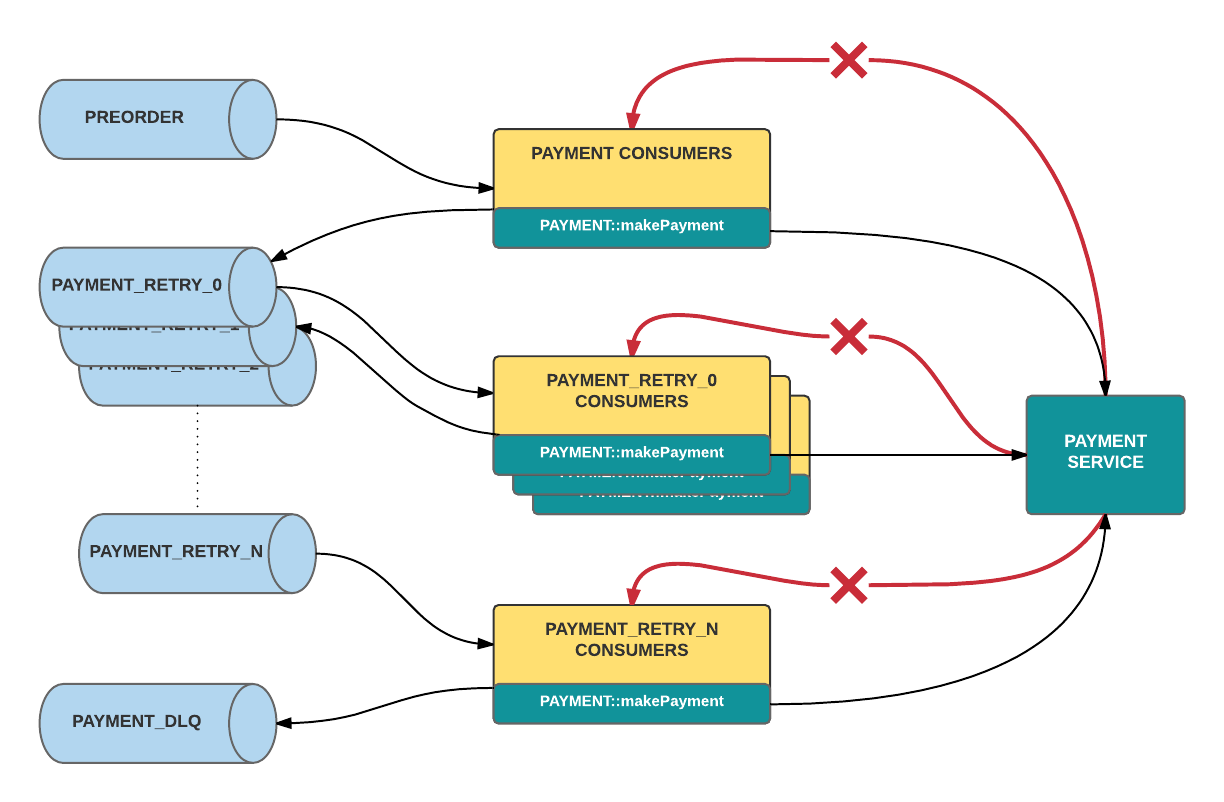
To address the problem of blocked batches, we set up a distinct retry queue using a separately defined Kafka topic. Under this paradigm, when a consumer handler returns a failed response for a given message after a certain number of retries, the consumer publishes that message to its corresponding retry topic. The handler then returns true to the original consumer, which commits its offset.
Retrying requests in this type of system is very straightforward. As with the main processing flow, a separate group of retry consumers will read off their corresponding retry queue. These consumers behave like those in the original architecture, except that they consume from a different Kafka topic. Meanwhile, executing multiple retries is accomplished by creating multiple topics, with a different set of listeners subscribed to each retry topic. When the handler of a particular topic returns an error response for a given message, it will publish that message to the next retry topic below it, as depicted in Figures 3 and 4.
Finally, the DLQ is defined as the end-of-the-line Kafka topic in this design. If a consumer of the last retry topic still does not return success, then it will publish that message to the dead letter topic. From there, a number of techniques can be employed for listing, purging, and merging from the topic, such as creating a command-line tool backed by its own consumer that uses offset tracking. Dead letter messages are merged to re-enter processing by being published back into the first retry topic. This way, they remain separate from, and are unable to impede, live traffic.
Figure 4: Errors trickle down levels of retry topics until landing in the DLQ.
It is important not to simply re-attempt failed requests immediately one after the other; doing so will amplify the number of calls, essentially spamming bad requests. Rather, each subsequent level of retry consumers can enforce a processing delay, in other words, a timeout that increases as a message steps down through each retry topic. This mechanism follows a leaky bucket pattern where flow rate is expressed by the blocking nature of the delayed message consumption within the retry queues. Consequently, our queues are not so much retry queues as they are delayed processing queues, where the re-execution of error cases is our best-effort delivery: handler invocation will occur at least after the configured timeout but possibly later.
Put client frameworks and libraries into an external process that acts as a proxy between your application and external services. Deploy the proxy on the same host environment as your application to allow control over routing, resiliency, security features, and to avoid any host-related access restrictions. You can also use the ambassador pattern to standardize and extend instrumentation. The proxy can monitor performance metrics such as latency or resource usage, and this monitoring happens in the same host environment as the application.
Deploy components of an application into a separate process or container to provide isolation and encapsulation. This pattern can also enable applications to be composed of heterogeneous components and technologies.
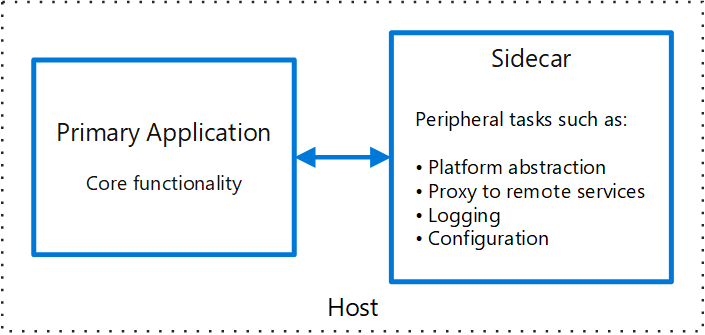
This pattern is named Sidecar because it resembles a sidecar attached to a motorcycle. In the pattern, the sidecar is attached to a parent application and provides supporting features for the application. The sidecar also shares the same lifecycle as the parent application, being created and retired alongside the parent. The sidecar pattern is sometimes referred to as the sidekick pattern and is a decomposition pattern.
Applications and services often require related functionality, such as monitoring, logging, configuration, and networking services. These peripheral tasks can be implemented as separate components or services.
If they are tightly integrated into the application, they can run in the same process as the application, making efficient use of shared resources. However, this also means they are not well isolated, and an outage in one of these components can affect other components or the entire application. Also, they usually need to be implemented using the same language as the parent application. As a result, the component and the application have close interdependence on each other.
If the application is decomposed into services, then each service can be built using different languages and technologies. While this gives more flexibility, it means that each component has its own dependencies and requires language-specific libraries to access the underlying platform and any resources shared with the parent application. In addition, deploying these features as separate services can add latency to the application. Managing the code and dependencies for these language-specific interfaces can also add considerable complexity, especially for hosting, deployment, and management.
Solution
Co-locate a cohesive set of tasks with the primary application, but place them inside their own process or container, providing a homogeneous interface for platform services across languages.
https://medium.com/netflix-techblog/distributed-delay-queues-based-on-dynomite-6b31eca37fbc Traditionally, we have been using a Cassandra based queue recipe along with Zookeeper for distributed locks, since Cassandra is the de facto storage engine at Netflix. Using Cassandra for queue like data structure is a known anti-pattern, also using a global lock on queue while polling, limits the amount of concurrency on the consumer side as the lock ensures only one consumer can poll from the queue at a time. This can be addressed a bit by sharding the queue but the concurrency is still limited within the shard.
We wanted the following in the queue recipe:
Distributed
No external locks (e.g. Zookeeper locks)
Highly concurrent
At-least-once delivery semantics
No strict FIFO
Delayed queue (message is not taken out of the queue until some time in the future)
Priorities within the shard
A queue is stored as a sorted set (ZADD, ZRANGE etc. operations) within Redis. Redis sorts the members in a sorted set using the provided score. When storing an element in the queue, the score is computed as a function of the message priority and timeout (for timed queues).
For each queue three set of Redis data structures are maintained:
A Sorted Set containing queued elements by score.
A Hash set that contains message payload, with key as message ID.
A Sorted Set containing messages consumed by client but yet to be acknowledged. Un-ack set.
Push
Calculate the score as a function of message timeout (delayed queue) and priority
Add to sortedset for queue
Add message payload by ID into Redis hashed set with key as message ID.
Poll
Calculate max score as current time
Get messages with score between 0 and max
Add the message ID to unack set and remove from the sorted set for the queue.
If the previous step succeeds, retrieve the message payload from the Redis set based on ID
Ack
Remove from unack set by ID
Remove from the message payload set
Messages that are not acknowledged by the client are pushed back to the queue (at-least once semantics).
Availability Zone / Rack Awareness
Our queue recipe was built on top of Dynomite’s Java client, Dyno. Dyno provides connection pooling for persistent connections, and can be configured to be topology aware (token aware). Moreover, Dyno provides application specific local rack (in AWS a rack is a zone, e.g. us-east-1a, us-east-1b etc.) affinity based on request routing to Dynomite nodes. A client in us-east-1a will connect to a Dynomite/Redis node in the same AZ (unless the node is not available, in which case the client will failover). This property is exploited for sharding the queues by availability zone.
Sharding
Queues are sharded based on the availability zone. When pushing an element to the queue, the shard is determined based on round robin. This will ensure eventually all the shards are balanced. Each shard represents a sorted set on Redis with key being combination of queueName & AVAILABILITY _ZONE.
Dynomite consistency
The message broker uses a Dynomite cluster with consistency level set to DC_SAFE_QUORUM. Reads and writes are propagated synchronously to quorum number of nodes in the local data center and asynchronously to the rest. The DC_SAFE_QUORUM configuration writes to the number of nodes that make up a quorum. A quorum is calculated, and then rounded down to a whole number. This consistency level ensures all the writes are acknowledged by majority quorum.
Avoiding Global Lock
Each node (N1…Nn in the above diagram) has affinity to the availability zone and talks to the redis servers in that zone.
A Dynomite/Redis node serves only one request at a time. Dynomite can hold thousands of concurrent connections, however requests are processed by a single thread inside Redis. This ensures when two concurrent calls are issued to poll an element from queue, they are served sequentially by Redis server avoiding any local or distributed locks on the message broker side.
In an event of failover, DC_SAFE_QUORUM write ensures no two client connections are given the same message out of a queue, as write to UNACK collection will only succeed for a single node for a given element. This ensures if the same element is picked up by two broker nodes (in an event of a failover connection to Dynomite) only one will be able to add the message to the UNACK collection and another will receive failure. The failed node then moves onto peek another message from the queue to process.
Queue Rebalancing
Useful when queues are not balanced or new availability zone is added or an existing one is removed permanently.
Handling Un-Ack’ed messages
A background process monitors for the messages in the UNACK collections that are not acknowledged by a client in a given time (configurable per queue). These messages are moved back into the queue.
Multiple consumers
A modified version can be implemented, where the consumer can “subscribe” for a message type (message type being metadata associated with a message) and a message is delivered to all the interested consumers.
Ephemeral Queues
Ephemeral queues have messages with a specified TTL and are only available to consumer until the TTL expires. Once expired, the messages are removed from queue and no longer visible to consumer. The recipe can be modified to add TTL to messages thereby creating an ephemeral queue. When adding elements to the Redis collections, they can be TTLed, and will be removed from collection by Redis upon expiry.
KafkaKafka provides robust messaging solution with at-least once delivery semantics. Kafka lends itself well for message streaming use cases. Kafka makes it harder to implement the semantics around priority queues and time based queue (both are required for our primary use case). Case can be made to create large number of partitions in a queue to handle client usage — but then again adding a message broker in the middle will complicate things further.
SQSAmazon SQS is a viable alternative and depending upon the use case might be a good fit. However, SQS does not support priority or time based queues beyond 15 minute delay.
DisqueDisque is a project that aims to provide distributed queues with Redis like semantics. At the time we started working on this project, Disque was in beta (RC is out).
Zookeeper (or comparable) distributed locks / coordinator based solutions.A distributed queue can be built with Cassandra or similar backend with zookeeper as the global locking solution. However, zookeeper quickly becomes the bottleneck as the no. of clients grow adding to the latencies. Cassandra itself is known to have queues as anti-pattern use case.